

The Rise of Clockwork Intelligence
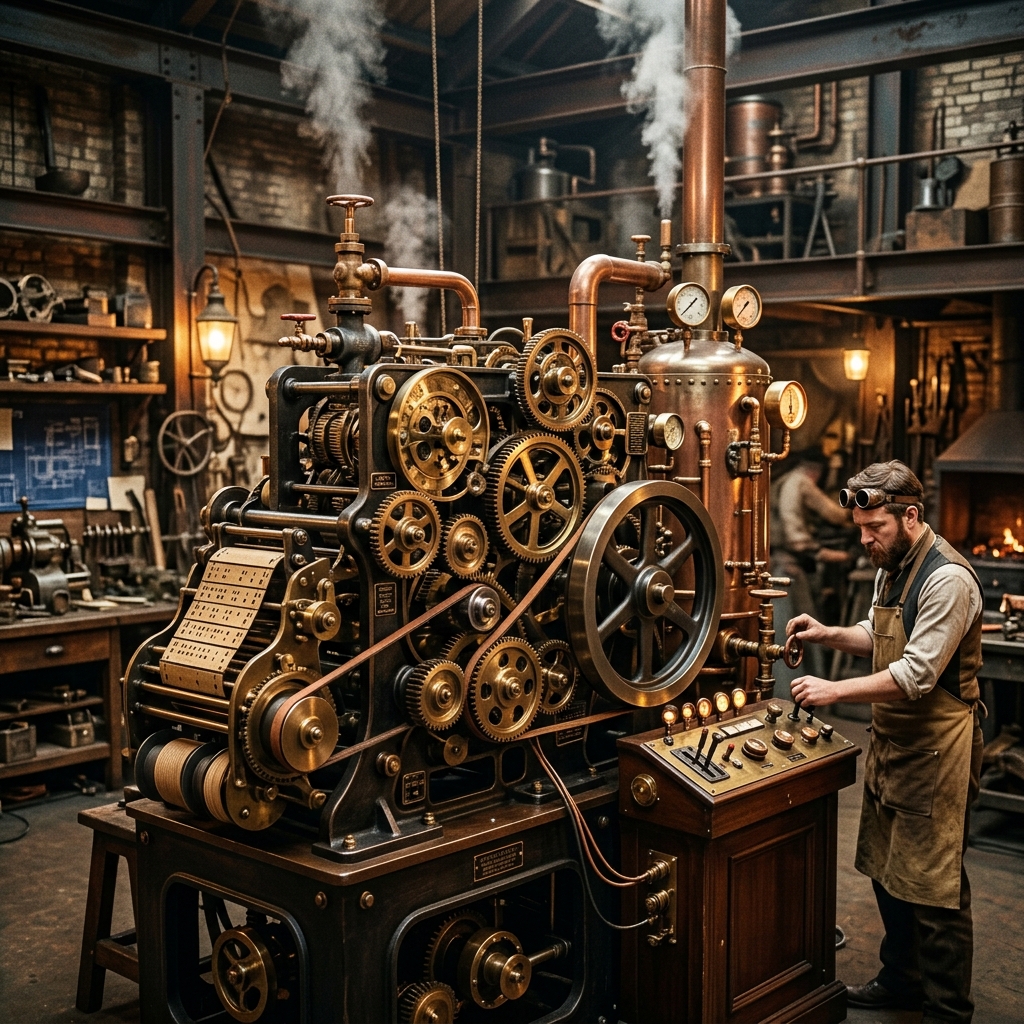
The dawn of the industrial era did not merely bring steam engines and automated weaving looms; it heralded a quiet revolution of copper, brass, and meticulously arranged clockwork. In the heart of Victorian innovation, engineers and scholars alike began to contemplate a radical vision: could analytical machinery transcend the mere arithmetic of addition and subtraction, and emerge as an active participant in intellectual design? The pursuit of clockwork intelligence has since become the defining quest of modern steampunk automation, blending pure physics with the artistry of Victorian metalwork.
The Foundations of Babbage's Analytical Paradigm
To understand the complexity of these clockwork systems, one must trace their lineage back to the visionary blueprinted schemas of Charles Babbage. Unlike simple calculators that relied on mechanical counters to perform basic ledger operations, the modern analytical engine operates using a complex system of decimal columns, gears, and rotating drum drums. The "mill" serves as the central processing core where logical calculations are performed, while the "store" operates as a mechanical memory bank capable of retaining hundreds of variables simultaneously. This segregation of calculation and storage represents a brilliant structural architecture, mirroring the fundamental layout of modern silicon-based computers, yet rendered entirely in physical space through the mesh of brass teeth.
The Physics of Steam-Powered Regulators
Automation in steampunk machinery is not merely a matter of locking gears in place; it requires constant, precise feedback control. This is accomplished via highly sophisticated centrifugal governor systems, powered directly by thermal steam pressure. As the analytical engine accelerates, the flyballs of the governor swing outward under centrifugal force, physically closing a throttle valve that regulates steam delivery to the mechanical cylinders. This delicate mechanical feedback loop ensures that gears rotate at a perfectly uniform velocity, preventing rapid accelerations that could cause delicate brass teeth to bind, shear, or suffer catastrophic failure. The result is a smooth, continuous hiss of steam, accompanied by the gentle, steady click-clack of precision mechanical logic.
Designing for Longevity: Alloys and Tolerances
One of the primary challenges facing Victorian metallurgists in this era is the selection of appropriate alloys. Pure copper is too soft, while traditional cast iron is prone to brittleness under rapid stress. Thus, custom phosphor-bronze and structural brass have become the materials of choice. Phosphor-bronze displays exceptional resistance to friction, making it ideal for the high-wear bearings that support rotating analytical shafts. In contrast, structural brass can be machined to microscopic tolerances, ensuring that thousands of distinct levers, wheels, and sliding registers align flawlessly. Lubricated with refined whale oil or modern graphite suspensions, these massive mechanical networks can operate indefinitely, executing complex routines day and night with minimal human intervention.
The Implication of Mechanical Reasoning
As analytical engines grow in capacity, the philosophical implications of their operation become impossible to ignore. If a machine can solve complex astronomical calculations, optimize shipping routes across the empire, and layout the engineering prints for its own replacement parts, where does calculation end and intelligence begin? Steampunk automation offers a compelling answer: intelligence is not solely the province of organic minds, but a property of highly ordered, complex structural relationships. The mechanical harmony of a well-calibrated engine is itself a form of logic, translating the chaotic energy of boiling water into the silent, beautiful architecture of structured thought. As we look to the future, the expansion of clockwork reasoning promises to unlock new frontiers of navigation, industry, and scientific inquiry, bridging the gap between cold metal and human imagination.