

Unlocking the Power of Quantum Algorithms
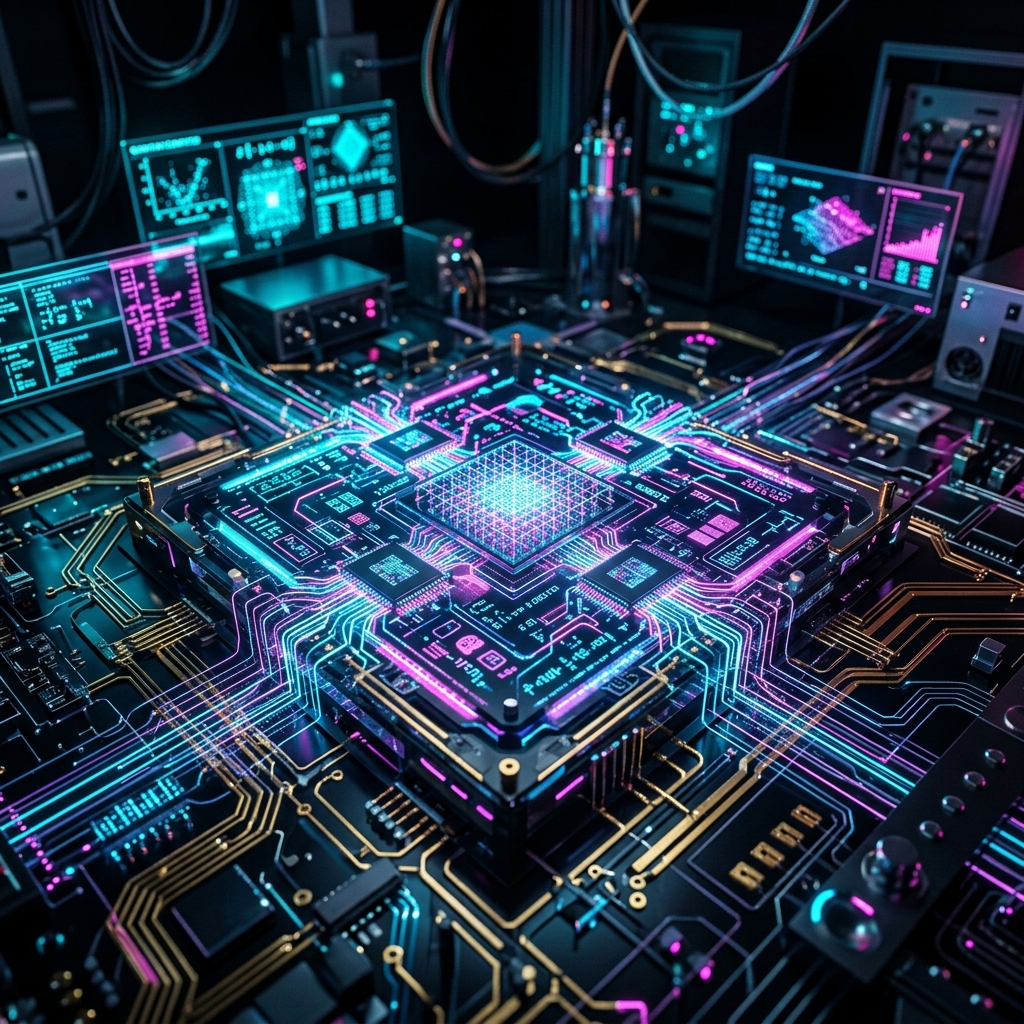
For more than half a century, the progress of global technology has been guided by Moore's Law—the observation that the number of transistors on a classical silicon microchip doubles roughly every two years. Today, however, classical hardware is rapidly approaching its physical limits, where transistors are so small that subatomic quantum effects begin to disrupt the flow of electrical currents. To break through this computing bottleneck, researchers are looking beyond classical bits and entering the realm of subatomic physics, unlocking an entirely new computing paradigm: quantum computing.
The Physics of Qubits: Beyond 1s and 0s
At the core of classical computers are bits—tiny electrical switches that represent either a 0 or a 1. Quantum computers, in contrast, operate using quantum bits, or qubits. Qubits are typically constructed from superconducting circuits or individual trapped ions cooled to temperatures colder than deep space. Thanks to the unique laws of quantum mechanics, qubits can exist in a state of superposition, representing both a 0 and a 1 simultaneously. When multiple qubits are combined, they can also undergo quantum entanglement—a phenomenon where the state of one qubit instantaneously determines the state of another, no matter the distance between them. This allows a quantum processor to evaluate an astronomical number of mathematical possibilities in parallel, solving problems that would take classical supercomputers thousands of years to compute.
Revolutionary Quantum Algorithms
Superposition and entanglement are only useful if they can be harnessed by structured logic. This is where quantum algorithms come in. Unlike classical software, which processes calculations sequentially, quantum algorithms utilize constructive interference to amplify correct answers while canceling out incorrect ones. The most famous example is Shor's Algorithm, which can factor large prime numbers in a fraction of a second. Since internet security relies on the difficulty of factoring primes, Shor's Algorithm has profound implications for digital cryptography, prompting a global shift toward post-quantum encryption standards. Another major algorithm is Grover's Algorithm, which provides a quadratic speedup for searching unsorted databases, fundamentally transforming how we analyze unstructured big data.
Transforming Scientific Frontiers
Beyond cryptography and database searches, the most immediate and profound impact of quantum computing will be felt in molecular chemistry and material science. Simulating the exact behavior of molecules on classical supercomputers is virtually impossible because the complex interactions of electrons scale exponentially. Quantum computers are naturally suited for this task because their qubits operate under the exact same quantum mechanical laws as the molecules they simulate. This capability will revolutionize drug discovery, allowing researchers to simulate and design novel molecular compounds in hours rather than decades, leading to highly targeted treatments for complex diseases. It will also accelerate the development of highly efficient solar cells, high-capacity batteries, and new room-temperature superconductors.
Charting the Quantum Future
We are currently living in the NISQ (Noisy Intermediate-Scale Quantum) era, where quantum processors are highly sensitive to environmental noise, requiring complex error-correction techniques to maintain stability. Despite these challenges, the rapid progress of quantum hardware and algorithmic research brings us closer to fault-tolerant quantum supremacy every day. By bridging the gap between subatomic physics and computing theory, quantum algorithms will unlock answers to some of humanity's most complex challenges, pioneering a new era of scientific discovery, secure communication, and global innovation that will redefine the boundaries of what is technologically possible.